Lately, I find myself entirely consumed by the indie roguelite genre. There is something satisfying about diving into a digital world knowing that every single attempt will be completely different from the last, yet you are constantly making incremental progress. This year alone, we have seen a wealth of stellar entries that fit this exact description, eating up weekends and evenings with their “just one more run” mentality.
Before we dive into my latest obsession, let us clarify a common point of confusion for the layman: the difference between a “roguelike” and a “roguelite”. In a traditional roguelike, when your character meets their untimely end, that is it. You start your next attempt from absolute scratch, armed with nothing but the painful knowledge of your past mistakes. A roguelite, however, is a bit more generous. While you still start a new run upon defeat, you carry over permanent upgrades, currency, or unlocked abilities. It creates a highly addictive loop where even a failed attempt makes you tangibly stronger for the next one. This satisfying progression loop brings us to the most delightful tactical puzzle of the year: Dog in the Machine.
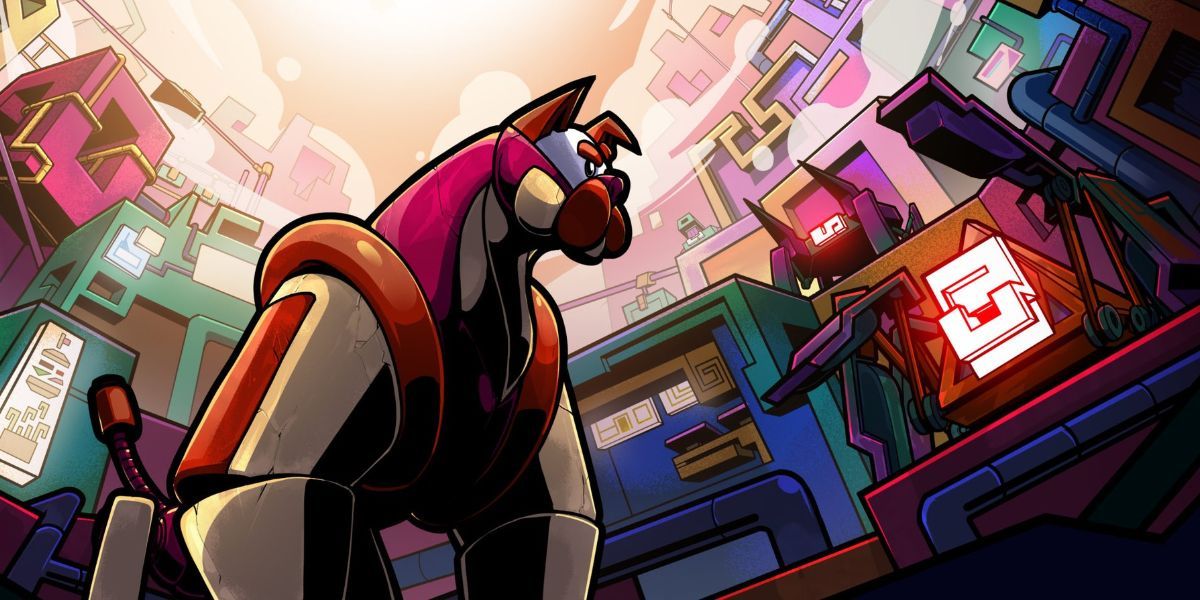
The premise of Dog in the Machine is equal parts charming and dystopian. You take control of an AutoDog (an adorable, highly customisable robotic canine) trapped deep inside a sprawling, mechanical metropolis. Your goal is to escape the cold, metallic clutches of this mecha-city and reunite with the exiled humans who are waiting somewhere beyond its towering walls.
The story is doled out through interactions with various quirky characters you meet in the safe zones between battles. These mechanical creatures slowly reveal the history of the city-machine, offering context without ever bogging down the pacing. The narrative serves as a pleasant, lighthearted backdrop that gives your robotic paws a clear reason to keep moving forward. You are not just fighting for survival; you are fighting for a reunion with your best friends.
Where Dog in the Machine truly captures the heart is in its visual presentation. The developers have leaned heavily into a classic Saturday morning cartoon mecha aesthetic. The bright, chunky cyber-dog designs instantly evoke memories of classic sci-fi cartoons centred on robotic canine companions. Looking at the AutoDog in action, you can immediately see the loving homages to characters like Goddard from The Adventures of Jimmy Neutron, Boy Genius and the gadget-filled, slightly clumsy charm of Dynomutt, Dog Wonder.
This vibrant art style is not just for nostalgia; it serves the gameplay beautifully. The animations are crisp, bouncy, and full of personality. When you trigger an attack, the physical comedy of the mecha-city reacting to your robotic dog feels lifted straight out of a Hanna-Barbera production. Enemies squash and stretch upon impact, and the visual flair of the environment reacting to your moves ensures that the game is always a joy to look at, even when you are plotting complex strategies.
Mechanics: The Good, The Bad, and The Explosive
At its core, Dog in the Machine is a tactical roguelite played out on compact, grid-based battlefields. Every single environment is generated to be a chain-reaction playground. The grids are littered with reactive elements, enemy guardians, conveyor belts, interactive buttons, and explosive hazards.
What the game does exceptionally well is removing the frustration usually associated with grid-based tactical puzzle games. It features a brilliant real-time preview system. Before you commit to any action, you can see exactly how your sequence of instructions will play out on the board. This means you can freely try, cancel, and retry your moves without any cognitive overload. You are essentially setting up a massive domino effect. When you finally hit the execute button and watch your AutoDog trigger a chain reaction that destroys waves of enemies in spectacular fashion, the feeling is immensely rewarding. If your AutoDog is defeated, you know exactly why; it is due to a flaw in your strategy rather than a careless misclick.
Progression feels deep and robust as well. After each battle, your AutoDog learns a new “Trick”. The real magic happens when you start combining two Tricks to create more complex manoeuvres. You can follow provided blueprints or experiment to invent your own combinations, essentially building a playstyle and a deck of moves that is entirely unique to your current run. You can also play as eight different dog breeds across an infinite number of procedurally generated levels, unlocking permanent upgrades between runs to tackle the higher difficulty tiers.
The Comparisons
If you enjoy the precise, grid-based tactical puzzle-solving of Into the Breach, and you love the deck-building synergy and run-based progression of Slay the Spire, you will absolutely enjoy Dog in the Machine. It takes the deterministic combat of the former and marries it to the customisable, modular arsenal of the latter, wrapping it all in a highly engaging, nostalgia-fuelled package.
The Verdict
Dog in the Machine manages to take deep, complex tactical combat and make it entirely accessible for everyone. It encourages experimentation over perfection and rewards creative thinking with visually spectacular, cartoonish results. The ability to craft your own playstyle through the modular Trick system ensures that no two runs ever feel exactly the same, and the vibrant retro aesthetic is simply a joy to experience.