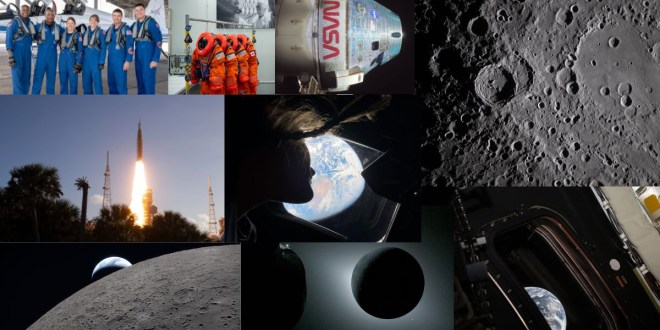

NASA’s Artemis II crew is preparing to return to Earth on Saturday morning Australian time, wrapping up humanity’s first crewed voyage to the Moon in more than half a century. Commander Reid Wiseman, pilot Victor Glover, and mission specialists Christina Koch and Canadian astronaut Jeremy Hansen are due to splash down in the Pacific Ocean off San Diego at approximately 10:07am AEST, capping a 10-day mission that saw them fly farther from Earth than any humans in history.
The mission has been a test flight for NASA’s Orion spacecraft, named Integrity by the crew, and a proving ground for systems that will underpin future lunar landings. During a seven-hour flyby of the Moon on 6 April, the four astronauts broke the distance record previously held by the Apollo 13 crew since 1970, travelling more than 252,000 miles from Earth. They also became the first people to observe parts of the lunar far side in daylight, witnessed a solar eclipse from behind the Moon, and reported possible meteorite impact flashes on the surface, observations scientists say could inform future landing site decisions.
The final minutes of the mission carry the highest stakes. The Orion capsule’s heat shield suffered unexpected cracking and material loss during the uncrewed Artemis I test flight in 2022. Rather than replace it, a process that would have added years of delay, NASA opted to modify the spacecraft’s re-entry trajectory to reduce heat exposure. The decision drew criticism from former astronaut and engineer Charles Camarda, who warned the agency’s analysis was insufficient, but NASA and several independent experts have expressed confidence the approach is sound. The capsule will endure temperatures approaching 2,800 degrees Celsius and forces of nearly four times Earth’s gravity during the 13-minute descent.
Australia has played a critical behind-the-scenes role throughout the mission. CSIRO’s Canberra Deep Space Communication Complex at Tidbinbilla, one of just three stations in NASA’s global Deep Space Network, has provided round-the-clock tracking and communications with the Orion spacecraft. When the CSIRO team is on shift, they operate not just the Canberra antennas but the entire network, including stations in California and Spain. Meanwhile, the Australian National University’s Quantum Optical Ground Station at Mount Stromlo has been demonstrating high-speed laser communications with the capsule, a technology that could give future Moon missions the equivalent of broadband internet in deep space.
Among the mission’s most striking moments were its most human. As the crew swung past the far side of the Moon and watched Earth disappear below the lunar horizon, they paused their science work to share Canadian maple cookies brought by Hansen. Wiseman later revealed his crewmates had quietly proposed naming a lunar crater after his late wife, Carroll, who died of cancer in 2020, a gesture he described as deeply moving. The crater name will be formally submitted to the International Astronomical Union after the mission. Pilot Glover, who becomes the first Black astronaut to travel to the Moon, described the experience of seeing Earth as a distant speck as something humans have not evolved to process.
The mission paves the way for an ambitious sequence of flights. Artemis III, planned for next year, will see astronauts practise docking with a lunar lander in Earth orbit, while Artemis IV in 2028 aims to land two astronauts near the Moon’s south pole, the first crewed lunar landing since 1972. Future Orion capsules will carry a redesigned heat shield. For now, the focus is on getting the Integrity crew safely through Earth’s atmosphere and onto the deck of the recovery ship USS John P. Murtha.